By the Structured Math Solutions Team
Subtraction with zeros in the minuend — a problem like 302 − 147 — tends to be one of the harder regrouping cases for 3rd graders. Weeks of practice on the written steps can still leave students subtracting the smaller digit from the larger one in each column, regardless of which number is on top, because the procedure was never firmly connected to what regrouping actually means.
The gap is usually not a student's ability to calculate — it's a missing bridge between concrete models and the abstract written steps. When a problem like 302 − 147 is taught only as a set of rules, students don't see the numbers as hundreds, tens, and ones; they see a sequence of steps to remember, with nothing to fall back on if a step is forgotten.
Procedural Without Conceptual
A student who has only memorized the steps for regrouping across a zero has no way to rebuild them if a step slips. A student who understands regrouping as decomposing a hundred into ten tens, and a ten into ten ones, can reconstruct the process from that understanding.
A Conceptual Regrouping Routine
A conceptual routine is a consistent sequence of steps students follow every time they regroup across a zero, grounded in place value rather than a memorized rule about "borrowing." The goal is for students to understand why a ten is being exchanged for ten ones, not just when to do it.
This works best when it moves through three stages: the concrete (base-ten blocks), the representational (drawings), and the abstract (the written numbers) — giving students more than one way to connect to the same regrouping step.
See the Routine in Practice
If you want to see exactly how this looks in a small-group lesson, you can download a free sample of the routine below.
Download Free Sample RoutineA 5-Step Sequence
This works well as a short daily routine — 5–10 minutes at the start of a small-group block, focused on one or two problems:
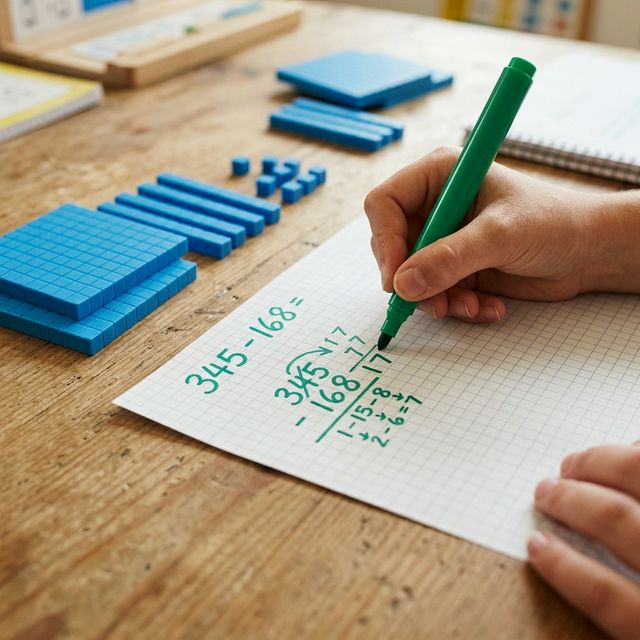
- 1. Read the place value: Students state what's in each place. For 302 − 147, that's 3 hundreds, 0 tens, and 2 ones.
- 2. Ask "is there enough?": Students check whether there are enough ones to subtract from — here, 2 is less than 7, so a trade is needed.
- 3. Trade a unit: Since there are 0 tens to trade from, students first decompose a hundred into 10 tens, then decompose one of those tens into 10 ones — seeing the value move between places, not just a digit change.
- 4. Update the numbers: Only after the model reflects the trade do students update the written numbers (2 hundreds, 9 tens, 12 ones).
- 5. Subtract each place: Subtract the ones, then the tens, then the hundreds, using the value now represented in each place.
Why Short Daily Practice Helps
Short, consistent daily practice tends to build more confidence than occasional long practice sessions. Working through one or two problems in this structured format each day can make regrouping across a zero feel like a familiar routine instead of a source of frustration, and can reduce how much reteaching is needed later.
Part of a Larger System
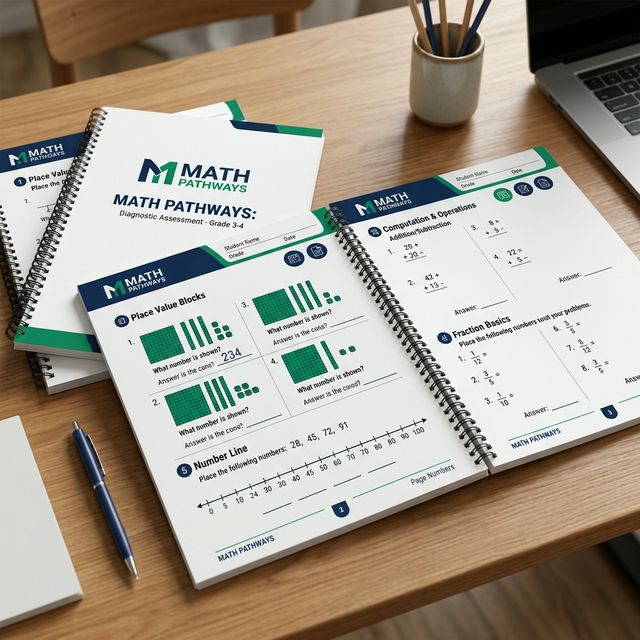
This routine focuses on subtraction, but the same daily structure — a short, focused routine connecting a model to the written procedure — applies across other skills too, from place value to fractions. A consistent structure across units tends to support retention better than skills taught in isolation.
Get the Subtraction Regrouping Sample
We've prepared a small-group sample of this routine for you to try this week.
What's included in the free sample:
- A complete conceptual routine for regrouping across a zero
- Ready-to-print student workspace pages
- A scaffolded teacher script for small groups
- Targeted exit tickets for quick checks
Building Toward Independence
The goal isn't for students to memorize a mechanical trick — it's for regrouping across a zero to become a routine they can reason through independently. A conceptual routine like this one takes more initial instruction time than teaching a shortcut, but it gives students something to fall back on when the numbers get harder.
Start with a 10-minute daily routine and give students consistent, structured practice with this specific regrouping case.
Try the Routine This Week
Download the free sample and see how this sequence fits into your small-group block.
Send Me the Free Sample