
By the Structured Math Solutions Team
If review stops the day a unit ends, many students will need reteaching by the time that skill resurfaces months later. A short daily routine that revisits earlier skills can help close that gap.
The Reteaching Cycle
You finish a two-week unit on place value. Students complete their notebook pages, participate in the activities, and do well on the end-of-unit assessment. Then a new unit starts — multi-digit addition — and when you ask students to identify the hundreds place, a good portion of the class draws a blank. Skills that aren't practiced regularly tend to fade, and reteaching them eats into time you'd planned for new content.
This is a common pattern in curricula built around discrete units: teach a skill, test it, move on, and don't return to it again until it resurfaces on a cumulative assessment months later.
What Spiral Review Is
Spiral review, sometimes called distributed practice, means revisiting previously taught skills on a regular basis instead of only once, right after they're introduced. Rather than teaching a skill and moving on permanently, you fold it back into a short daily routine alongside whatever is currently being taught.
Distributed practice — spacing out exposure to a skill over time instead of massing it all at once — is a widely studied strategy in learning research. The classroom version doesn't need to be complicated: a few minutes a day, connecting current and previously taught skills, rather than one test and no further review.
Try a Sample Week
If you want to see how this looks in practice, you can download a free, ready-to-use sample week for your classroom below.
Download the Free 1-Week SampleWhy a Daily Routine Can Help
Repeated exposure to a skill over time tends to support longer-term retention better than a single block of intensive practice all at once. A few reasons a short daily routine can be useful:
- Supports retention over time: Recalling a skill weeks or months after it was first taught — rather than only right after learning it — is a well-studied way to help it stick.
- Keeps a mix of skills active: Seeing a variety of previously taught skills regularly, not just the current unit, can help students stay comfortable applying older skills instead of treating them as finished and forgettable.
- Gives you ongoing formative data: A daily routine gives you a regular, low-stakes read on which skills are slipping, so you can make small adjustments before a major assessment.
- Offers extra exposure without falling behind: For students who need more practice with an earlier skill, the daily routine provides that repetition without pulling them out of the current pace of instruction.
A 10-Minute Routine
A common concern is that spiral review will take too much time. In practice, it works best as a short, consistent part of the day — often the first 5–10 minutes, whether that's morning work, a transition after recess, or the start of the math block.
1. Use a Consistent Format
A predictable layout — like a simple grid where the location and type of problems stay the same each day — means students spend their attention on the math instead of figuring out how the page works.
2. Mix the Skills
Include a variety of concepts each day. For a 3rd grade classroom, that might be one box for place value, one for a short word problem, one for basic computation, and one previewing or reviewing a geometry skill.
3. Keep the Review Short
About 5–7 minutes of independent practice, followed by a short check where you model the most missed problem, gives students quick feedback before a misconception has a chance to settle in.

Treating It as a Full-Year System
Spiral review tends to work best as a consistent, full-year routine rather than an occasional worksheet. A regular daily structure gives students more chances to revisit earlier skills over the course of the year than isolated review sessions can, and it signals that every skill taught still matters after the unit test.
A Ready-Made Option
Building your own daily review from scratch takes time. If you're looking for a full-year option, our 180-Day 3rd Grade Math Spiral Review Bundle provides a structured daily practice sequence covering 3rd grade skills through consistent repetition.
Try a Free Sample of the System
We've put together a sample pack you can try in your classroom before deciding if the full system is a fit.
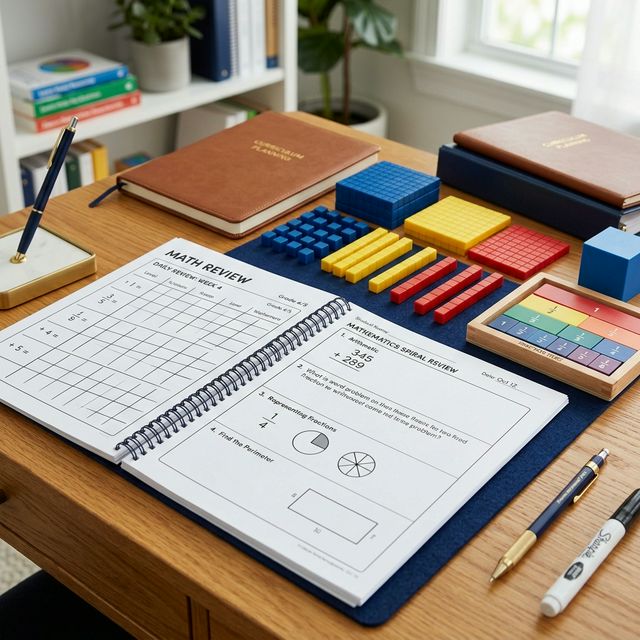
What's included in the free sample:
- 5 full days of daily math review pages
- Format aligned to 3rd grade skills
- A complete answer key for fast grading or student self-check
- Ready-to-print student workspaces
A Practical Habit, Not a Cure-All
Spiral review won't replace solid initial instruction, but it can meaningfully reduce how much reteaching you need later in the year by giving students repeated, low-stakes exposure to skills they've already learned.
Start With One Week
Download the free sample and see how a short daily routine fits into your existing math block.
Download Free Sample Week