By the Structured Math Solutions Team
If students ask "Where do I put this?" more often than they ask math questions, the procedure is probably the thing that needs simplifying.
The "What Do I Do Now?" Chorus
You're at the small-group table, ready to explain a regrouping strategy, when three students interrupt at once — one can't find a pencil, one doesn't know where the worksheet is, one is wandering near the sink. A chunk of instructional time disappears before the lesson even starts.
Management in a 3rd grade math block often has less to do with being stricter and more to do with how many procedural decisions students have to make just to begin a task. When students have to navigate a maze of directions to start, confusion tends to show up as behavior.
Why Rotation Systems Can Struggle
Many classrooms use rotation charts with several stations, each with its own set of expectations. Asking students — whose executive function is still developing at this age — to track four or five different sets of directions can pull their attention away from the math itself and onto the logistics of the rotation. When the procedure is hard to follow, off-task behavior tends to follow with it.
A rotation can look "successful" simply because students stay busy, but staying busy and engaging with the math aren't the same thing. When the activity at a station is unclear or the accountability is low, the room tends to feel less organized even if students are technically doing something.
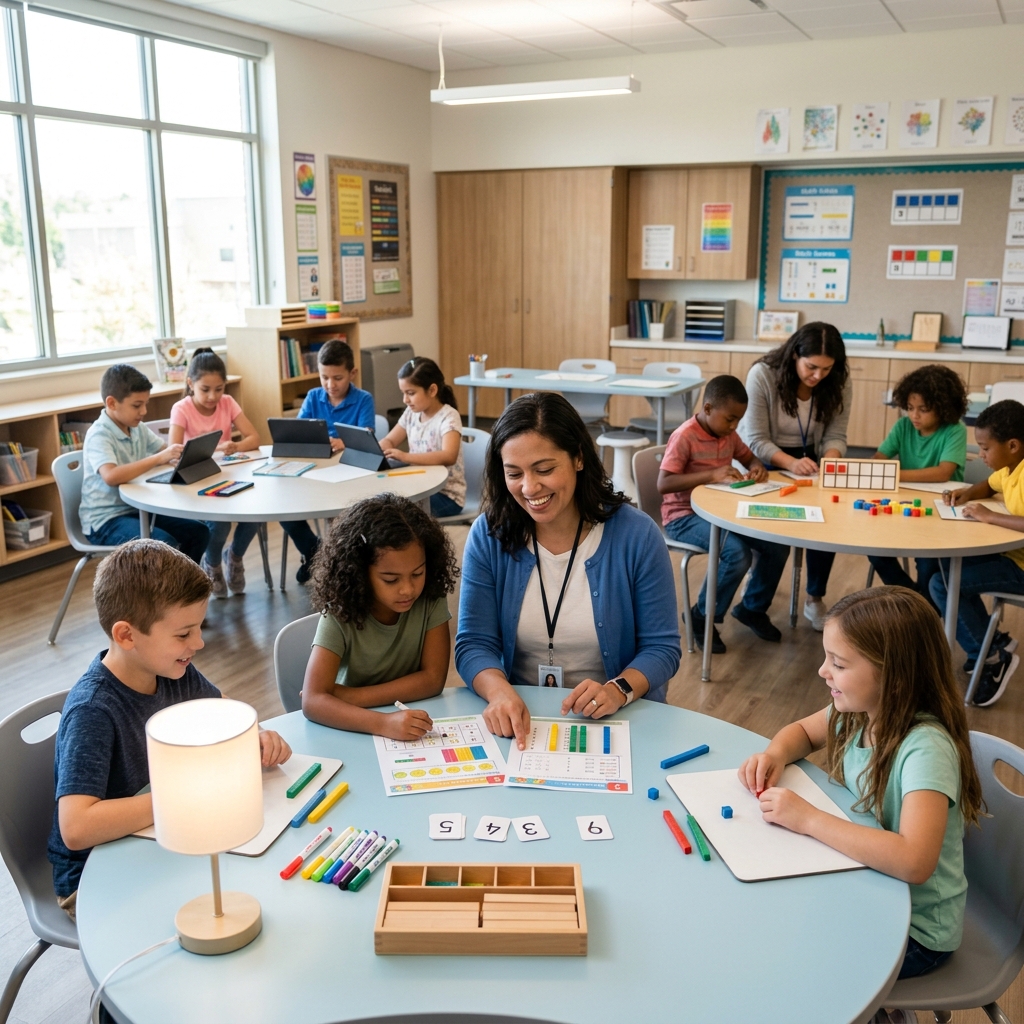
A Simpler 3-Station Routine
One way to reduce the procedural load is to move from several stations down to three, which cuts down on transitions and the number of different directions students have to track:
- Station 1 — Teacher-Led: Focused, high-structure instruction on the current unit's core skill.
- Station 2 — Structured Practice: A consistent workspace format where students apply what was just taught, without new directions to learn.
- Station 3 — Spiral Review: Independent review of previously taught skills, so earlier learning stays active while you're at your table.
A Consistent Workspace
Using the same workspace format across every math unit — whether students are working on place value or fractions — means the "where" and "how" of getting started stay the same from week to week. When the format is familiar, students spend less time asking procedural questions and more time on the math itself.
Transitions tend to go more smoothly too: students already know where their materials are and what the first step looks like, so you're not re-explaining directions each time you start a new rotation.
See the Rotation System
Our Small Group Rotation System includes the layout, templates, and procedures for building a 3-station routine like this one.
Explore the Rotation System →A System, Not a Personality Trait
Simplifying the block — a 3-station rotation, a consistent workspace, clear expectations at each station — tends to reduce daily friction more reliably than any one teacher's classroom-management style. Building the system usually does more of the work than trying to manage each disruption individually.