By the Structured Math Solutions Team
It's the second week of school, you're starting the first whole-group lesson, and it's already clear the class is a wide mix: some students are ready to move quickly, others are missing foundational skills the lesson assumes they already have. Without a clear read on where each student stands, it's hard to know who needs a different kind of support, or what that support should actually target.
A short, focused math placement diagnostic at the start of the year can make that picture much clearer — not by testing everything a student might know, but by identifying which specific foundational gaps are worth addressing first.
Data Is Only Useful If It Leads to a Plan
Many beginning-of-year assessments are long, reading-heavy, and disconnected from what happens in the classroom the next day. A diagnostic is most useful when its results point directly to which small-group routines a student needs — not just a score.
Why Long Assessments Can Miss the Mark
Students who are already struggling often have a harder time with lengthy, reading-heavy tests. They can get overwhelmed, guess, or disengage — and the resulting data may say more about test endurance than about actual mathematical understanding. A useful diagnostic stays short and focused enough to reflect a student's real thinking, while still surfacing the specific gaps that matter.
Try the Diagnostic
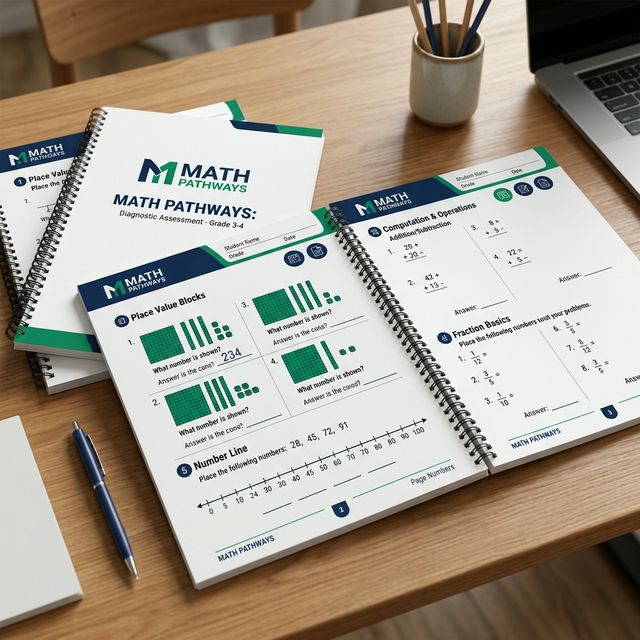
Want to see how this looks in practice? Download a free sample of the Structured Math Placement Diagnostic below.
Download Free Diagnostic ToolFrom Diagnostic Results to Groups
When scoring a diagnostic, look for patterns across students, not just individual scores. If five students all miss the rounding questions but handle basic addition well, that's a group ready to form around a specific skill.
- Place value gap: A regrouping-focused small-group routine.
- Slow, inaccurate computation: A daily fluency-focused spiral review.
- Fraction confusion: A unit-fraction visual model routine.
- Word problem struggle: An I Do, We Do, You Do modeling sequence focused on reasoning, not keywords.
Moving From Assessment to Action
It's not necessary to review every skill before starting small groups. Using the diagnostic to identify the highest-priority gaps and starting small-group routines around those first tends to build momentum faster than trying to cover everything at once.
Get the Placement Diagnostic Sample
We've put together a 35-question placement diagnostic you can use for small-group planning.
- 35 targeted, multi-skill questions
- A teacher answer key with common-error notes
- A small-group planning template
- Ready-to-print student copies
A Clearer Starting Point
Identify the gaps, form the groups, and start small-group instruction with a specific plan instead of a guess.
Join the Community & Download